
An air conditioner that runs but delivers warm or only slightly cool air is one of the most disorienting HVAC problems a homeowner can encounter. The system appears to be working, but isn’t doing its job. In most cases, warm air from a running AC points to a problem with the refrigerant level, the compressor or the components that control them. Unfortunately, none of these can be assessed or repaired without professional equipment and a licensed technician.
Before calling for service, check that the thermostat is set correctly, confirm the filter isn’t severely clogged and make sure the outdoor unit is running. Then, call HVAC 911 for a referral to a local technician who can identify the actual cause. Continuing to run a system that is blowing warm air can cause additional damage, so getting a technician involved promptly is the right call.
Emergency HVAC Repair Services | HVAC 911
What’s Happening
Air conditioning works by moving heat, not by generating cold air. Refrigerant circulates between the indoor evaporator coil and the outdoor condenser coil, absorbing heat from indoor air at the evaporator and releasing it outside at the condenser. The compressor is the component that drives this cycle, pressurizing the refrigerant and keeping it moving through the system.
When a running system blows warm air out the vents, something has disrupted this heat transfer process. Either the refrigerant isn’t at the right charge level to absorb heat effectively, the compressor isn’t pressurizing the refrigerant correctly or a component controlling either of these functions has failed.
The severity of your unit producing warm or slightly cool air doesn’t always correlate directly with the urgency of the underlying problem. A system that is mildly low on refrigerant may still produce slightly cooled air for a period before performance degrades further. A system with a failing compressor may run seemingly normally until it completely fails. In either case, the system will not heal itself. The condition will worsen, and continued operation under a refrigerant or compressor problem can cause damage to other components that a timely repair would have protected.
Why It Happens
The most common cause of warm air from a running AC is a low refrigerant charge due to a leak in the system. Refrigerant doesn’t get consumed the way fuel does. A properly sealed system holds its charge indefinitely. When the charge drops, it means refrigerant has escaped through a leak somewhere in the refrigerant circuit. That could be from a fitting, valve, coil joint or damaged section of refrigerant line. A system with insufficient charge can’t absorb enough heat from the indoor air to produce meaningful cooling, and the warm air at the vents is the most noticeable symptom. Simply adding refrigerant without finding and repairing the leak is a temporary fix. The charge will drop again, and the underlying leak will continue to worsen.
The second major cause is compressor failure or reduced compressor capacity. The compressor is the component that pressurizes refrigerant and drives it through the refrigerant circuit. A failing compressor may still run, but if it can no longer generate adequate pressure. This causes the refrigerant cycle to slow or stall, and the system loses its ability to transfer heat. Compressor problems can develop gradually, with progressively warmer air and longer run times before a complete failure. It can also occur suddenly. Compressor failure is among the more significant HVAC repairs, which is why the replace-or-repair assessment discussed in the context of aging systems is particularly relevant when a compressor is involved.
A third category of causes involves electrical component failures that affect compressor operation, specifically, a failed capacitor or contactor. The capacitor provides the starting and running power boost the compressor motor needs, and a weakened or failed capacitor may cause the compressor to start and run intermittently or not at all — even while the fan and other components continue operating normally. The contactor is the switch that allows power to reach the compressor and condenser fan. A worn or pitted contactor can interrupt power delivery, resulting in inconsistent or no cooling despite the outdoor unit appearing to run. Both are relatively straightforward repairs when caught early and diagnosed correctly.
What You Can Safely Do Now
There are a handful of checks homeowners can safely perform before calling a technician. These checks won’t diagnose the underlying problem, which requires professional equipment, but they can rule out simple causes and give the technician useful information when they arrive.
- Confirm the thermostat is set to cool and the set point is below the current room temperature. A thermostat accidentally switched to heat or fan-only mode is a common source of warm air that doesn’t require a service call. Check the mode setting and the set point before anything else.
- Check and replace the air filter if it’s severely clogged. A completely blocked filter can restrict airflow to the point where the evaporator coil freezes over, stopping the system from cooling and resulting in air that feels warm or barely cool. If the filter is visibly matted with debris, replace it and give the system 30 to 60 minutes to recover before evaluating performance again.
- Check whether the outdoor unit is running. Go outside and confirm the outdoor condenser unit is operating — both the fan on top and the unit itself should be running when the system is calling for cooling. If the indoor air handler is running but the outdoor unit is silent or only partially operating, that’s important information for the technician.
- Check the AC system circuit breakers. Most central AC systems have two breakers in the main panel — one for the indoor air handler and one for the outdoor unit. A tripped breaker on the outdoor unit can cause the air handler to run while the compressor is offline, producing warm air. Reset a tripped breaker once. If it trips again immediately, do not reset it; call a technician.
- Look for ice on the indoor unit or refrigerant lines. Ice forming on the evaporator coil or on the refrigerant lines running to the outdoor unit indicates airflow restriction or a low refrigerant charge. If you see ice, turn the system off but turn the fan on to help the ice thaw. Then call a technician. Running a frozen system accelerates compressor damage.
- Note when the problem started and whether anything changed around that time. A warm air problem that started suddenly after a power outage, a storm or a period of very high outdoor temperatures provides useful diagnostic context. A problem that developed gradually over several weeks suggests a different category of cause than one that appeared overnight.
When to Call an HVAC Technician
Call a technician if the homeowner-level checks listed above don’t identify an obvious cause and the system is still producing warm or insufficiently cool air. Refrigerant and compressor issues cannot be diagnosed or resolved without professional equipment, and there is no homeowner-accessible fix for either.
Calling sooner rather than later matters because a system running with a refrigerant or compressor problem places additional stress on components that are functioning normally, and the repair scope can expand the longer the system runs in a compromised state.
If you notice any of the following, treat them as urgent, turn the system off and call immediately:
-
- Visible ice on the coil or lines that doesn’t clear within an hour of switching the system off
- A loud banging, grinding or rattling sound from the outdoor unit while it’s running, which can indicate a compressor or fan motor in mechanical distress
- A burning smell or visible scorch marks near the outdoor unit or the indoor air handler
- A breaker that trips repeatedly after being reset.
These conditions indicate that the system should not continue operating until a technician has assessed it.
What HVAC Service Technicians See in the Field
HVAC Technicians responding to warm-air complaints regularly find systems where the homeowner has been adding refrigerant — sometimes repeatedly with a consumer-grade product — without identifying or repairing the underlying leak. Refrigerant additions without leak repair are a temporary measure at best, and the practice can mask a leak long enough for it to grow from a minor seep into a more significant failure point. When a technician arrives to find a system that has been topped off multiple times, the leak detection process becomes more involved, and in some cases, the refrigerant circuit has been compromised in ways that make a proper repair more complex than if a technician were brought in earlier.
Capacitor failures are another consistent finding on warm-air calls. The system appears to be operating, the outdoor unit is on and the homeowner has waited several days for conditions to improve before calling. By that point, running the compressor against a failing capacitor has placed thermal stress on the compressor motor windings. In most cases, the compressor is still serviceable, but the window for a simple capacitor replacement has narrowed and now also involves assessing compressor health. Capacitor failures are inexpensive repairs when caught early and significantly more consequential when the compressor runs through them unattended.
What an HVAC Technician Will Do
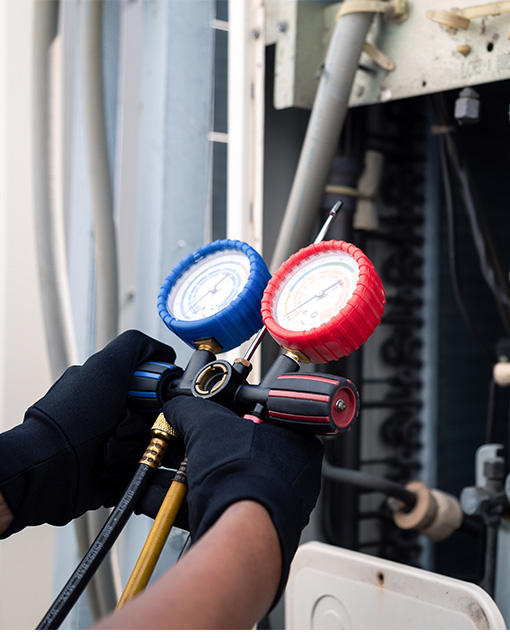
When a technician arrives for a warm air complaint, the diagnostic process begins with a system performance check. This includes measuring supply air temperature at the vents, checking the temperature differential between return and supply air, measuring amperage draw at the compressor and assessing refrigerant pressure on both the high and low sides of the system. These measurements tell the technician quickly whether the system is low on refrigerant, whether the compressor is generating adequate pressure and whether the electrical components are delivering power correctly.
If the refrigerant is low, the technician will perform a leak search using detection equipment to locate the source before adding any charge. Once the leak is found and repaired, the system will be evacuated, recharged to the manufacturer’s specification and retested to confirm correct performance. If the compressor or a capacitor is the issue, the technician will confirm the diagnosis, advise on repair versus replacement based on the system’s age and condition, and complete the repair using tested components. At the end of the visit, the technician should provide a written summary of what was found, what was done and the refrigerant charge the system was set to. This documentation can be useful for future service visits and for warranty purposes.
Be Prepared
After a refrigerant leak repair, monitor the system’s cooling performance over the following week. A system that was correctly repaired and recharged should maintain its set temperature without unusually long run times. If performance begins to degrade again within a season after a leak repair, that’s a signal that the leak may not have been fully sealed or that a second leak point exists in the system, and a follow-up call is warranted rather than waiting through another season of reduced performance.
Ask the technician at the end of any compressor or refrigerant service call whether any other components showed signs of stress during the diagnostic process. A system that has been running with a refrigerant or compressor problem for weeks stresses the capacitor, contactor and fan motors. A technician who has just assessed the full system is the best source of a realistic picture of what else may need attention before the next cooling season.
If the repair involved a compressor replacement or a significant refrigerant circuit repair on a system more than 10 years old, ask the technician for an honest assessment of the system’s remaining useful life and whether the current repair changes the replace-or-repair calculus. A major repair on an aging system is sometimes the right call, but it’s also sometimes the inflection point where a replacement — particularly with current incentive programs available — makes more long-term sense. Having that conversation while the technician’s findings are fresh gives you the information you need to plan rather than react.
FAQs
Can I add refrigerant to my AC to fix the warm air problem?
No, and attempting to do so creates additional problems. Refrigerant handling requires EPA certification, and it’s regulated because of its environmental impact. Consumer-grade refrigerant products sold at hardware stores are not a substitute for professional service. More importantly, adding refrigerant without finding and repairing the leak that caused the loss only postpones the problem. The refrigerant will leak again on the same timeline, and repeated additions without leak repair can contaminate the refrigerant circuit, complicating proper repair later. If your system is low on refrigerant, the correct course of action is to have a technician perform leak detection, repair the source and recharge the system to specification.
My outdoor unit is running, but the air inside is barely cool. Does that mean the compressor is failing?
Not necessarily. This is exactly why professional diagnosis matters rather than assumption. An outdoor unit that appears to be running can have several problems that produce the same warm-air symptom. It could be a failed run capacitor that allows the fan to run but reduces compressor capacity, a low refrigerant charge, a refrigerant circuit restriction or a compressor that is genuinely failing. Each has a different repair path and a different cost implication. A technician can distinguish between these causes in minutes using pressure and electrical measurements that aren’t available to homeowners. A diagnosis based solely on symptoms frequently leads to unnecessary component replacements or to missed actual causes.
What happens if I keep running the AC while it’s blowing warm air?
It depends on the cause, but in most cases, continued operation worsens the situation. A system low on refrigerant that keeps running will eventually cause the compressor to overheat. Compressors rely on refrigerant flowing through them for lubrication and cooling, and insufficient charge starves the compressor of both. A system with a failing capacitor that continues to run places thermal stress on the compressor motor windings. In both cases, what might have been a refrigerant repair or a capacitor replacement becomes a compressor replacement if the system runs long enough. Turning the system off and calling a technician promptly is almost always less expensive than running through the problem.
Is a refrigerant leak always in the same place, or can it be anywhere in the system?
Leaks can occur at any point in the refrigerant circuit: fittings and connections, evaporator or condenser coil, service valves or along the refrigerant lines. Coil leaks are particularly common in older systems where the coil material has thinned over the years of use and temperature cycling. Fitting and connection leaks are common at points where vibration or thermal expansion has worked a joint loose over time. Since leaks can be anywhere in the circuit, a proper leak search uses detection equipment — electronic leak detectors, UV dye or both — rather than visual inspection alone. A technician who simply adds refrigerant without a systematic leak search is not providing a complete repair, and the homeowner should ask specifically whether a leak search was performed and where the leak was found before accepting the work as complete.
Call HVAC 911
If your AC is running but blowing warm air, getting a qualified technician involved quickly is the most reliable way to prevent a manageable repair from becoming a major one. Compressor and refrigerant issues don’t resolve on their own and tend to worsen the longer the system runs in a compromised state.
HVAC 911 is a referral service affiliated with the top local licensed, bonded and insured HVAC contractors in the area. They employ highly qualified technicians who have completed over 10,000 hours of training and undergone rigorous background checks. Call HVAC 911 today!

