
When outdoor temperatures climb into the upper 90s (or higher!), your air conditioning system works harder, runs longer and costs more to operate. How much more depends on how well the system is maintained and how the home around it is managed.
Homeowners who keep their filter current, seal obvious air leaks and have the system professionally serviced before peak season consistently see lower cooling bills than those who don’t, even with identical equipment.
Before the next heat wave arrives, change your filter, check your thermostat settings and schedule a professional tune-up if your system hasn’t been serviced this season. If your AC is running constantly without reaching your set temperature, call an HVAC technician before conditions get worse.
Air Conditioner Maintenance Services | HVAC 911
What’s Happening
Summer heat events — extended stretches of temperatures well above seasonal averages — are the true stress test for residential air conditioning systems. During these periods, a system that performs adequately on a typical summer day may run continuously without reaching the thermostat’s set point, consume substantially more electricity per hour than its efficiency rating suggests, and in some cases, fail under the sustained load. Utility bills that seemed manageable in June can look dramatically different after a two-week stretch of 95-degree days in July.
What makes this particularly worth your time is that the gap between a well-maintained system and a neglected one widens significantly under heat stress. A system with a clean coil, correct refrigerant charge and unobstructed airflow handles peak demand far more efficiently than one with even moderate accumulated maintenance deficits. The efficiency difference between a well-tuned AC unit and one that has been running without service for two or three seasons can be substantial — and that difference shows up directly on the electricity bill every month the system runs.
Why It Happens
The most direct cause of excessive cooling costs during heat events is a system that is working harder than it needs to because of deferred maintenance. A dirty evaporator coil — the indoor component that absorbs heat from the air — loses heat transfer efficiency as airborne debris accumulates on its surface. A coil that is even modestly fouled requires more refrigerant cycles to achieve the same cooling effect, which means longer run times, higher electricity consumption and more wear on compressor components. Most homeowners never see the evaporator coil and have no way to assess its condition without a technician’s inspection, which is why this is the maintenance item most likely to go unaddressed.
A second major factor is heat entering the home faster than the AC can remove it. Air conditioning doesn’t just fight outdoor temperature — it fights every source of heat gain inside the home. This includes solar radiation through windows and roof surfaces, heat conducted through walls and attic floors, internal heat from appliances and lighting and heat infiltrating through gaps in the building envelope. On a 100-degree day, a home with single-pane windows, poor attic insulation and significant air leakage places a cooling load on the AC system that even a perfectly maintained unit will struggle to manage. Understanding and reducing heat gain — not just running the AC harder — is the most sustainable approach to managing cooling costs during extreme heat.
Thermostat behavior contributes a third dimension. A thermostat set to respond to a single point in the home rather than actual occupancy patterns keeps the AC running at full capacity during hours when no one is home or when reduced cooling would be perfectly comfortable. Homes without programmable or smart thermostats often maintain the same set point around the clock — cooling an empty house to the same temperature as a fully occupied one, regardless of time of day or outdoor conditions. This is one of the highest-leverage efficiency adjustments available to homeowners and requires no equipment purchase to begin capturing.
What You Can Safely Do Now
There is a meaningful range of steps homeowners can take without professional help that directly reduce the cooling load on the system and lower the cost of each hour it runs. The cumulative effect of several of these done together is often more significant than any single action.
- Change the air filter if it hasn’t been replaced in 30 to 90 days. A clogged filter restricts airflow through the system, forcing the blower to work harder and reducing the volume of air the coil can condition per hour. This is the single lowest-cost, highest-impact maintenance step available to homeowners and should be done before any heat event.
- Set the thermostat higher when the home is unoccupied. Every degree higher reduces the compressor’s run time meaningfully. Setting the thermostat up by several degrees during work hours and returning it to comfort level before you arrive home — ideally through a programmable or smart thermostat — captures significant efficiency without sacrificing comfort during occupied hours.
- Use window coverings to reduce solar heat gain during peak sun hours. Closing blinds or curtains on south- and west-facing windows during the afternoon hours reduces the amount of solar radiation entering the home and directly lowers the cooling load. This is particularly effective in rooms with large windows that receive direct afternoon sun.
- Run heat-generating appliances during cooler parts of the day. Dishwashers, ovens, dryers and even lighting generate heat that the AC system has to remove. Running these appliances in the morning or evening rather than during the hottest part of the afternoon reduces internal heat gain when the system is already under its greatest outdoor load.
- Clear the area around the outdoor condenser unit. The condenser needs unobstructed airflow on all sides to reject heat effectively. Vegetation, stored items or debris within two feet of the unit make it work harder. Clear a two-foot perimeter and remove any debris lodged in the condenser fins.
- Check that all supply and return vents are open and unobstructed. Closing vents in unused rooms doesn’t save energy in most systems — it increases static pressure and reduces system efficiency. Confirm that vents throughout the home are open and that furniture, rugs and curtains aren’t blocking return air grilles.
When to Call an HVAC Technician
Call a technician if your system runs continuously for extended periods without the home reaching the thermostat’s set temperature, if your electricity bill has increased noticeably compared to the same period last year with no obvious explanation, or if the system is more than a year past its last professional service. These conditions all point to a system that is either working inefficiently, losing refrigerant capacity or has a maintenance deficit that the homeowner-level steps can’t address. A technician can identify and correct the underlying cause rather than leaving the system to compensate by running longer and costing more with each passing week.
Treat the following as urgent: ice forming on the refrigerant lines or the indoor unit, which indicates airflow or refrigerant problems that will worsen if the system keeps running; a system that shuts itself off before the set temperature is reached and doesn’t restart promptly; or unusual sounds — grinding, squealing or banging — during operation. Any of these is a signal to turn the system off and call a technician rather than pushing through a heat event on a system that is showing signs of imminent failure.
What HVAC Service Technicians See in the Field
Technicians responding to efficiency complaints during heat events regularly find systems where the homeowner has been managing comfort with the thermostat rather than addressing the system’s underlying condition. The pattern is familiar: the homeowner noticed the house felt warmer than usual, lowered the thermostat set point to compensate, the system ran longer to meet the new target, the electricity bill went up and the cycle repeated. By the time a technician arrives, the set point may be five degrees lower than the homeowner actually needs for comfort — and the system is running almost continuously to chase a target that a well-maintained unit at a more reasonable set point would handle comfortably.
Technicians also consistently find condenser coils that are significantly more fouled than the homeowner expected. The outdoor condenser unit collects cottonwood, grass clippings, dust and airborne debris on its fins throughout the season, and a coil that appears reasonably clean from a distance may have a compacted debris layer between the fins that dramatically reduces heat rejection capacity. Homeowners who ask why their AC seems to struggle more in July than in June often find that a condenser cleaning — a routine part of a professional tune-up — restores a meaningful portion of the system’s efficiency. The unit hasn’t aged or lost refrigerant. It simply can’t reject heat through a fouled coil.
What an HVAC Technician Will Do
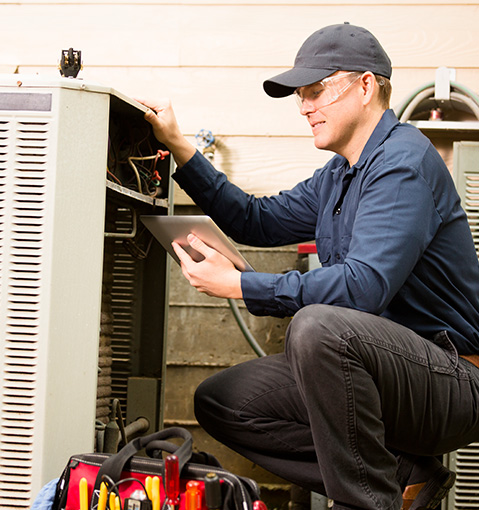
During a maintenance visit focused on efficiency, a technician will clean both the evaporator and condenser coils, check the refrigerant charge and inspect for leaks, test electrical components, including the capacitor and contactor, measure airflow across the evaporator and verify that the blower motor is operating within specifications. The thermostat calibration will be confirmed, the condensate drain line will be checked and flushed and the technician will assess whether the system’s current efficiency performance is consistent with its age and rated specifications.
At the end of the visit, the technician should walk you through the findings and provide a written summary. Ask specifically about refrigerant levels — a system that is even slightly low on refrigerant loses efficiency disproportionately to the amount of charge it has lost. Ask whether any components are showing wear that will affect performance before the end of the season. Also, ask what set point range the technician recommends for your system’s capacity and your home’s insulation profile — a technician who has just measured the system’s performance is the best source of a realistic, efficient target temperature for a home like yours.
Be Prepared
After any maintenance visit, keep the service summary with your system’s records and note the date, the findings and the technician’s recommendations. If your system has a known efficiency limitation — a unit that is slightly undersized for the home or an older system with a lower efficiency rating than current standards — document that as context for understanding your cooling bills during extreme heat events. Knowing your system’s realistic ceiling helps you set expectations and make informed decisions about whether an upgrade makes sense before the next cooling season.
Before the technician leaves, ask whether your home has obvious opportunities to reduce cooling load — attic insulation gaps, air leakage points at windows or doors or duct sections in unconditioned spaces that are losing conditioned air. HVAC technicians see enough homes to recognize patterns, and a brief conversation about your home’s building envelope can point you toward improvements that lower your cooling costs more than any amount of thermostat adjustment.
If efficiency has been a recurring concern across multiple seasons, schedule a full system evaluation rather than annual maintenance alone. A technician doing a focused efficiency assessment can identify whether the issue is the system, the home’s envelope or the combination, and can recommend whether a repair, an upgrade or a building improvement will deliver the most meaningful return.
FAQs
Does closing vents in unused rooms save energy during a heat event?
In most systems, no, and it can actually reduce efficiency. Central air conditioning systems are designed to operate against a specific static pressure in the duct system. Closing vents increases that pressure, which reduces airflow through the system, causes the evaporator coil to run colder than designed and can lead to the coil freezing. A frozen coil stops cooling the home entirely and requires the system to be turned off until it thaws. Keeping all vents open and allowing the system to distribute air as designed is more efficient than selectively closing rooms, even rooms that aren’t being used.
My system hasn’t been serviced in two years, but it seems to be working. Do I really need a tune-up?
A system that appears to be working may still be operating at reduced efficiency in ways that don’t show up as obvious comfort problems until a heat event puts it under full load. Coil fouling, a refrigerant charge that has drifted slightly low and a capacitor that is still functioning but approaching failure are all conditions that don’t prevent the system from running, but do increase the energy cost. Two years without service means two years of accumulated coil fouling and component wear. A tune-up before a heat event typically pays for itself within the season through efficiency improvement alone — and it eliminates the risk of discovering a failing component during a heat wave when service calls are hardest to schedule.
How much difference does thermostat setting actually make on my cooling bill?
Each degree lower on the thermostat set point increases cooling energy use meaningfully. The exact amount depends on your home’s insulation, the outdoor temperature and your system’s efficiency rating. Setting the thermostat several degrees higher during unoccupied hours and returning it to a comfortable level before occupancy — through a programmable or smart thermostat — is one of the highest-leverage efficiency adjustments available without any equipment investment. The other thermostat-related savings opportunity is recognizing the difference between a set point that the system can reach efficiently and one it can only approach by running continuously. A home that maintains 76 degrees with the system cycling normally uses significantly less energy than one set to 72 degrees that runs almost without stopping.
Is there a point where my AC system is too old to be worth maintaining for efficiency?
Generally, yes. Systems more than 15 years old are operating at efficiency ratings that were the standard of their time, but are significantly below what current equipment achieves. A well-maintained older system will always perform better than a neglected one, but there’s a point where the efficiency gap between the existing system and a current-generation replacement is large enough that a replacement delivers a better return. This is especially true if the existing system has had multiple repairs in recent years. A technician can give you an honest assessment of where your system stands on that curve. If your system is approaching that threshold, a conversation about replacement before it fails during a heat event gives you time to choose and schedule on your terms rather than under emergency pressure.
Call HVAC 911
If your cooling bills are climbing faster than the temperature outside, or if your system is working harder than it should to keep your home comfortable, a professional assessment is the fastest way to identify what’s costing you and what can be done about it. A technician can restore efficiency that the homeowner-level steps can’t reach and give you a clear picture of your system’s current performance.
HVAC 911 is a referral service affiliated with the top local licensed, bonded and insured HVAC contractors in the area. They employ highly qualified technicians who have completed over 10,000 hours of training and undergone rigorous background checks. Call HVAC 911 today!

